A community of amateur astronomers sharing the wonder of the night sky with the central Willamette Valley. Monthly meetings, star parties, public outreach, and a passion for the cosmos.
What's Coming Up
Join us for meetings, star parties, and virtual observing sessions. See the full 2026 schedule →
Watch your HVAAstronomy groups.io email or Facebook for confirmations and weather updates.
Night Sky Guide
Step outside this month and catch these highlights — no telescope required for most!
| Date | Time | What to Look For |
|---|---|---|
| 7 | Morning | The waning crescent Moon rises with the Pleiades in the east-northeast. |
| 9 | Morning | The crescent Moon and Mars rise side by side above the east-northeastern horizon. |
| 10 | Dawn | The Moon, almost at new phase, forms a triangle with Castor and Pollux. |
| 11 | Dawn | Look toward the east-northeastern horizon and see if you can detect the very thin lunar crescent with Mercury about 2° to the lower right. |
| 12–13 | All night | The Perseid meteor shower peaks. The Moon won't be a factor. Have you seen any Perseids yet? This is a long event from mid-July to the later part of August. |
| 15 | Dusk | In the west-southwest the waxing crescent Moon leads Venus about 4° as they slide to the horizon. |
| 16 | Dusk | In the west-southwest the waxing crescent Moon is about 6° to the lower right of Spica. |
| 20 | Evening | The waxing gibbous Moon and Antares are a pretty pair in the south-southwest. |
| 28 | Full Moon (9:19 P.M. PDT) | Partial lunar eclipse — only the Moon's north polar region stays out of the Earth's umbra. |
All times are PDT. Check the Clear Dark Sky chart and local weather before heading out.
This Month's Constellation
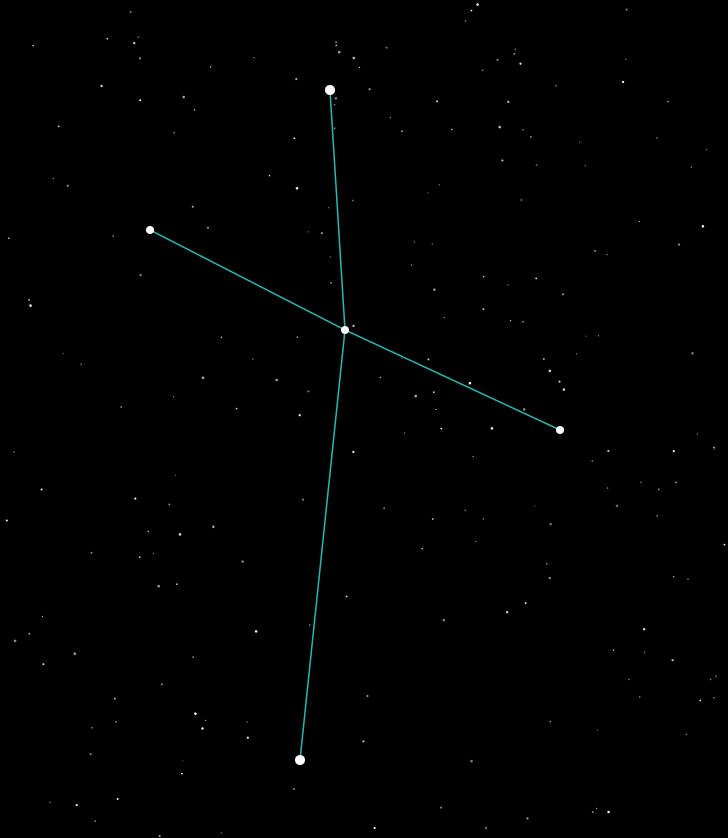
High overhead on August evenings, Hercules is home to the Great Globular Cluster (M13), one of the finest deep-sky objects in the northern sky.
Hercules is the fifth-largest constellation in the sky, representing the kneeling hero of Greek mythology. Its most famous feature is M13 — the Great Globular Cluster, a dense ball of several hundred thousand stars visible with binoculars under dark skies.
Look for the four stars forming the "Keystone" asterism at the center of the constellation — M13 lies along one edge of it, about a third of the way from the northern to the southern star.
The constellation also harbors several nice double stars and galaxy groups for telescopic observers.
Learn more about Hercules →About the Club
The Heart of the Valley Astronomers (HVAA) is a community of amateur astronomers in the central Willamette Valley of Oregon, dedicated to sharing our passion for the night sky with the local community.
We welcome everyone — beginners with binoculars, experienced deep-sky observers, astrophotographers, and those who simply love looking up. No telescope? No problem.
The group meets on the second Tuesday of each month, either via Zoom or in person at the Scott Zimbrick Memorial Fire Station 5: 4950 NW Fair Oaks Drive, Corvallis, OR 97330.
We also run telescope tune-up nights, educational outreach for schools, and regular star parties at dark-sky sites like Adair County Park.
Explore
Everything you need to get the most out of the night sky.