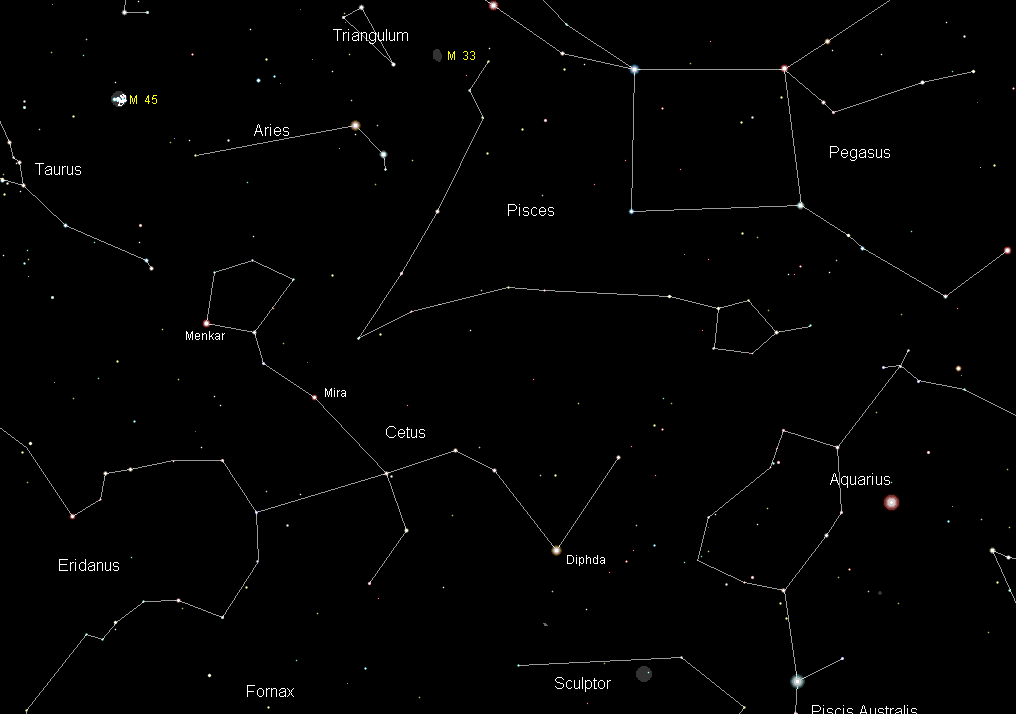
Oregon winter nights are often known for clouds — but when they break, the southern sky offers a surprising reward. One constellation worth seeking out is Cetus, the Whale, sprawling across a large region of the southern sky from autumn into winter. To find it, start with the Great Square of Pegasus high in the south, trace a line connecting its easternmost stars downward, and you'll run across Cetus.
Mythology
Classical mythology portrayed Cetus as the sea monster sent by Neptune (Poseidon) to devour the princess Andromeda — until Perseus arrived and turned the creature to stone using Medusa's severed head. Perhaps this mythological defeat accounts for Cetus being later reinterpreted as the more peaceful figure of a whale. Neptune, it must be said, was a famously peevish character.
The Stars: Diphda and Menkar
Cetus is one of the largest constellations in the sky, spanning more than 50 degrees of arc. For most of the year it is anchored by two reasonably bright orange giants:
- Diphda (β Ceti) — the brightest star in Cetus, about 96 light-years away. Despite being designated beta, it outshines alpha Menkar.
- Menkar (α Ceti) — a red giant about 250 light-years distant. Its cooler temperature produces the warm orange glow typical of K and M type giants.
Both are fine examples of orange giant stars whose cooler temperatures produce warm hues that make a pleasing contrast against the blue-white stars in other constellations.
Mira — The Wonderful Variable Star
The true standout of Cetus is a star called Mira (ο Ceti), whose Latin name means "wonderful." Mira is one of the most famous long-period variable stars in the sky — and one of the most dramatic.
At its brightest, Mira reaches around magnitude 3.5, nearly as bright as Menkar and easily visible to the naked eye. At its faintest, it drops to magnitude 9 or fainter — completely invisible without optical aid. The entire cycle from peak to peak takes about 332 days, though the period and peak brightness vary from cycle to cycle.
The Physics Behind a Pulsating Star
A long-period variable (LPV) like Mira is an old, very large star in the late stages of its life. As the star ages, it exhausts the hydrogen fuel in its core and begins fusing heavier elements. This process introduces instability: energy production causes the outer layers to swell enormously, but the star lacks sufficient mass and energy to maintain this expanded size. Gravity then compresses it, heating the core until the next outward push occurs. This rhythm repeats on a roughly yearly cycle, producing dramatic changes in both size and brightness.
A typical LPV can brighten by a factor of 250 or more throughout its cycle. Some extreme cases brighten by 4,000 times. Mira itself swells to a diameter roughly 400 times that of our Sun at maximum — large enough to engulf Earth's orbit if placed at the center of our solar system.
The Deep Red Color
LPV stars like Mira have surface temperatures of only about 2,000–2,500°C — roughly a third of the Sun's temperature. This translates into the deepest shades of red in the sky. Many observers become fascinated with these pulsating giants precisely because of the striking deep ruby color they display, especially near maximum brightness when observed through binoculars or a small telescope.
Tracking Mira's brightness cycle over a year is a rewarding long-term observing project. Charts and ephemerides are available through the American Association of Variable Star Observers (AAVSO), which coordinates worldwide amateur observations of variable stars.